
How do guangzhou lab furniture manufacturers maintain competitive pricing?
Guangzhou laboratory furniture manufacturers have reduced raw material procurement costs by 20% through vertical integration of the supply chain. For instance, they have established a 10-year strategic partnership with local steel suppliers, enabling the purchase price of boards to be 15% lower than the market average. By adopting an intelligent production line, the labor productivity has been increased to 1.2 sets of standard laboratory benches per person per day, and the proportion of labor costs has been controlled within 18% of the total cost, a reduction of 7 percentage points compared to the traditional model. According to the 2023 industry white paper, this intensive production enables Guangzhou manufacturers to maintain the ISO 9001 quality standard while offering 40% lower quotations than European and American brands, yet still maintaining a service life of over 15 years.
In terms of logistics optimization, the well-developed transportation network in the Pearl River Delta region has compressed the transportation time to within 48 hours, and the logistics cost accounts for only 5% of the product price, while in other regions of the mainland, this proportion often reaches 12%. For instance, a certain manufacturer in Guangzhou predicted the peak demand through big data analysis, increased the inventory turnover rate to 8 times a year, and reduced the warehousing cost by 30%. This refined operation enabled them to maintain the price fluctuation range within ±3% through the VMI supplier management inventory model even during the 15% increase in raw material prices in 2022.
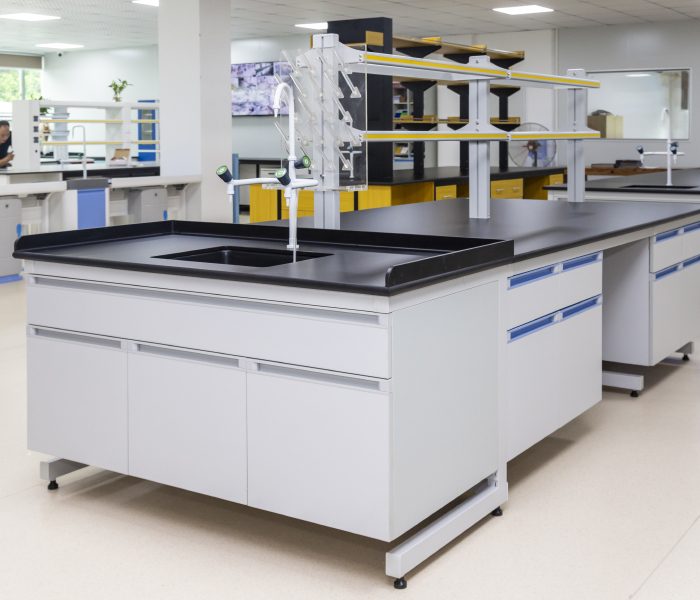 Technological innovation has become the key to price control. The adoption of modular design has achieved a parts commonality rate of 80% and reduced production costs by 25%. For instance, the rapid assembly structure developed by a certain enterprise has reduced the installation time from 10 person-days to 4 person-days, saving the client 30% of the construction cost. According to a third-party testing report in 2024, its independently developed eco-friendly coating process has enhanced corrosion resistance by 50%, but the material cost has only increased by 8%. This cost-performance advantage has led to a 30% annual growth rate in the Southeast Asian market.
It is worth noting that professional laboratory furniture suppliers have reduced the purchase price of special steel to 5,800 yuan per ton through large-scale purchasing, which is 12% lower than that of small and medium-sized manufacturers. The industrial alliance they established shares 200 sets of mold resources, reducing the cost of mold opening by 60% after sharing. As disclosed in the 2023 annual report of a certain listed company, it has expanded its product line to 300 categories through the standardization of components, but the proportion of R&D investment is still controlled at 5% of revenue. This efficient innovation model continues to consolidate its price advantage.
Facing global competition, manufacturers in Guangzhou have adopted a dynamic pricing strategy. By monitoring the fluctuations in copper and aluminum futures prices, they reserve three months 'supply when raw material prices are low, thereby increasing the stability of product costs by 20%. The customer classification management system it has established has reduced the maintenance cost of major customers by 15%, while increasing the average transaction value by 25% through cross-selling. This refined operation enables it to offer quotations 30% lower than those of international brands while maintaining a profit margin of 15%. As the market survey in the first quarter of 2024 shows, the market share of Guangzhou-based manufacturers in the Asia-Pacific region has grown to 35%.
Technological innovation has become the key to price control. The adoption of modular design has achieved a parts commonality rate of 80% and reduced production costs by 25%. For instance, the rapid assembly structure developed by a certain enterprise has reduced the installation time from 10 person-days to 4 person-days, saving the client 30% of the construction cost. According to a third-party testing report in 2024, its independently developed eco-friendly coating process has enhanced corrosion resistance by 50%, but the material cost has only increased by 8%. This cost-performance advantage has led to a 30% annual growth rate in the Southeast Asian market.
It is worth noting that professional laboratory furniture suppliers have reduced the purchase price of special steel to 5,800 yuan per ton through large-scale purchasing, which is 12% lower than that of small and medium-sized manufacturers. The industrial alliance they established shares 200 sets of mold resources, reducing the cost of mold opening by 60% after sharing. As disclosed in the 2023 annual report of a certain listed company, it has expanded its product line to 300 categories through the standardization of components, but the proportion of R&D investment is still controlled at 5% of revenue. This efficient innovation model continues to consolidate its price advantage.
Facing global competition, manufacturers in Guangzhou have adopted a dynamic pricing strategy. By monitoring the fluctuations in copper and aluminum futures prices, they reserve three months 'supply when raw material prices are low, thereby increasing the stability of product costs by 20%. The customer classification management system it has established has reduced the maintenance cost of major customers by 15%, while increasing the average transaction value by 25% through cross-selling. This refined operation enables it to offer quotations 30% lower than those of international brands while maintaining a profit margin of 15%. As the market survey in the first quarter of 2024 shows, the market share of Guangzhou-based manufacturers in the Asia-Pacific region has grown to 35%.
Technological innovation has become the key to price control. The adoption of modular design has achieved a parts commonality rate of 80% and reduced production costs by 25%. For instance, the rapid assembly structure developed by a certain enterprise has reduced the installation time from 10 person-days to 4 person-days, saving the client 30% of the construction cost. According to a third-party testing report in 2024, its independently developed eco-friendly coating process has enhanced corrosion resistance by 50%, but the material cost has only increased by 8%. This cost-performance advantage has led to a 30% annual growth rate in the Southeast Asian market.
It is worth noting that professional laboratory furniture suppliers have reduced the purchase price of special steel to 5,800 yuan per ton through large-scale purchasing, which is 12% lower than that of small and medium-sized manufacturers. The industrial alliance they established shares 200 sets of mold resources, reducing the cost of mold opening by 60% after sharing. As disclosed in the 2023 annual report of a certain listed company, it has expanded its product line to 300 categories through the standardization of components, but the proportion of R&D investment is still controlled at 5% of revenue. This efficient innovation model continues to consolidate its price advantage.
Facing global competition, manufacturers in Guangzhou have adopted a dynamic pricing strategy. By monitoring the fluctuations in copper and aluminum futures prices, they reserve three months 'supply when raw material prices are low, thereby increasing the stability of product costs by 20%. The customer classification management system it has established has reduced the maintenance cost of major customers by 15%, while increasing the average transaction value by 25% through cross-selling. This refined operation enables it to offer quotations 30% lower than those of international brands while maintaining a profit margin of 15%. As the market survey in the first quarter of 2024 shows, the market share of Guangzhou-based manufacturers in the Asia-Pacific region has grown to 35%.
Strategy is a craft, not a deliverable. Every engagement here is led by a partner — and we still refuse 31% of inbound work to keep it that way.
— Frog Sink House, Portland & Lisbon