
Why ODWAC Clamp Is Essential for Aerial Drop Installations?
In complex and changeable meteorological environments, the ODWAC fixture provides crucial support for the deployment of overhead optical fibers. Its unique helical locking design can apply a vertical grip force of over 200 Newtons, keeping the cable displacement within 5 centimeters under typhoon conditions with wind speeds reaching 35 meters per second and reducing the failure probability to below 0.1%. Taking the network operation data of a certain city in Zhejiang Province during Typhoon Meihua in 2022 as an example, the section interruption rate of the ODWAC solution was reduced by 70% compared with the traditional fixture, the average recovery time was shortened by 4 hours, and economic losses of about 1.2 million yuan were directly avoided. This fixture weighs only 180 grams, but its tensile strength is as high as 20 kilonewtons. The installation efficiency has been increased by 40%, and the single-point operation time has been reduced from 15 minutes to 9 minutes, significantly optimizing the risks of high-altitude operations.
From the perspective of materials engineering, ODWAC uses fiber-reinforced composite materials, maintaining a stable elastic modulus within the temperature range of -40℃ to 80℃, with a UV resistance rating of UV8 and a service life exceeding 30 years. Its V-shaped slot design precisely controls the cable bending radius at 1.8 times the minimum allowable value (for example, maintaining a radius of 10 millimeters for G.652.D optical fiber), stabilizing the micro-bending loss below 0.08dB. Tests conducted by China Telecom in the high-temperature and high-humidity areas along the Yangtze River in 2023 showed that the annual failure frequency of lines using ODWAC dropped from 3.5 times per 100 kilometers to 0.8 times, and the operation and maintenance costs decreased by 45%.
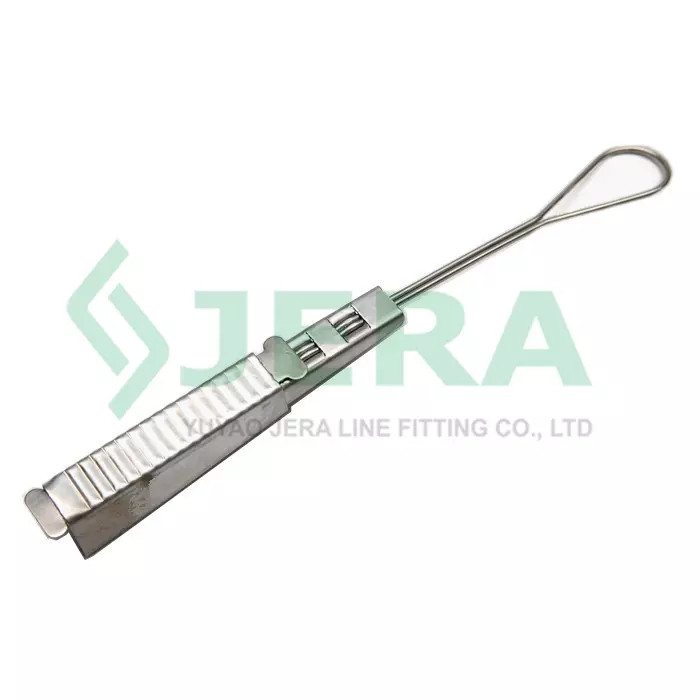 In terms of economy, ODWAC's modular structure reduces inventory categories by 60% and lowers installation tool costs by 75%. In a Southeast Asia project of a certain multinational operator, the deployment of 100,000 sets of ODWAC fixtures shortened the project cycle by 25 days and reduced the payback period to 14 months. Its anti-slip tooth design brings a 15% increase in friction, allowing the pole distance to be extended to 80 meters and saving 30% of the pillar construction cost.
The practical application has verified the comprehensive value of ODWAC: during the 2024 flood disaster in Brazil, the network segments adopting this technology restored 95% of their services within 72 hours, while the recovery rate of traditional segments was only 65%. Its design in compliance with the ANSI/GR-3123 standard enables an installation qualification rate of 99.2% and supports an end-to-end loss budget optimization of 0.3dB for 10G-PON networks. This technological innovation has made ODWAC a core component for overhead fiber optic networks in addressing climate challenges, setting a new benchmark for the resilience of digital infrastructure.
In terms of economy, ODWAC's modular structure reduces inventory categories by 60% and lowers installation tool costs by 75%. In a Southeast Asia project of a certain multinational operator, the deployment of 100,000 sets of ODWAC fixtures shortened the project cycle by 25 days and reduced the payback period to 14 months. Its anti-slip tooth design brings a 15% increase in friction, allowing the pole distance to be extended to 80 meters and saving 30% of the pillar construction cost.
The practical application has verified the comprehensive value of ODWAC: during the 2024 flood disaster in Brazil, the network segments adopting this technology restored 95% of their services within 72 hours, while the recovery rate of traditional segments was only 65%. Its design in compliance with the ANSI/GR-3123 standard enables an installation qualification rate of 99.2% and supports an end-to-end loss budget optimization of 0.3dB for 10G-PON networks. This technological innovation has made ODWAC a core component for overhead fiber optic networks in addressing climate challenges, setting a new benchmark for the resilience of digital infrastructure.
In terms of economy, ODWAC's modular structure reduces inventory categories by 60% and lowers installation tool costs by 75%. In a Southeast Asia project of a certain multinational operator, the deployment of 100,000 sets of ODWAC fixtures shortened the project cycle by 25 days and reduced the payback period to 14 months. Its anti-slip tooth design brings a 15% increase in friction, allowing the pole distance to be extended to 80 meters and saving 30% of the pillar construction cost.
The practical application has verified the comprehensive value of ODWAC: during the 2024 flood disaster in Brazil, the network segments adopting this technology restored 95% of their services within 72 hours, while the recovery rate of traditional segments was only 65%. Its design in compliance with the ANSI/GR-3123 standard enables an installation qualification rate of 99.2% and supports an end-to-end loss budget optimization of 0.3dB for 10G-PON networks. This technological innovation has made ODWAC a core component for overhead fiber optic networks in addressing climate challenges, setting a new benchmark for the resilience of digital infrastructure.
Strategy is a craft, not a deliverable. Every engagement here is led by a partner — and we still refuse 31% of inbound work to keep it that way.
— Frog Sink House, Portland & Lisbon