
Veneer, Melamine, PVC and HPL: Upgrading a Fibreboard Face
A raw fibreboard panel is a substrate; the face decides what it becomes. Dongstar publishes four covering routes, melamine paper, HPL, PVC and leather, over base boards listed as raw MDF, MHR MDF (Green), FR MDF (Red) and HDF (Black), with nine wood-grain species plus solid colours, fabric and marble effects also published for the same range.

Key takeaways
- Four coverings are published: melamine paper, HPL, PVC and leather, on one face or both.
- Base board comes first: raw MDF, MHR MDF (Green) for humid interiors, FR MDF (Red) where fire performance is specified, HDF (Black) where a harder surface is wanted.
- Surface treatment is a separate list from covering: matt, textured, glossy, embossed and magic.
- Nine wood-grain species are named, from beech and oak to sapele, wenge and rosewood, alongside solid colours, fabric and marble looks.
What a raw board can and cannot do
Raw MDF and HDF are uniform, flat and easy to machine, which is why they are used as substrates rather than as finished faces. What a raw panel cannot do is hide a seam, resist a spill for years, or carry a decorative pattern. Those are the jobs the covering takes over, and they are decided before the board is ordered rather than after it is cut.
That order of decisions matters commercially. A buyer who chooses a grain first and a base board second may end up with a decorative panel that swells at a sink unit, or a fire-rated board carrying a covering that was never intended for it. The published lists separate base board, covering and surface treatment so the three can be chosen in the right sequence.
The four covering routes, one by one
Melamine paper is the workhorse of the four: it presses directly onto the board, holds colour and pattern well, and is published as an option on one or both faces. HPL is a thicker laminate supplied as a sheet and bonded afterwards, which makes it harder wearing and easier to replace in service. PVC brings a flexible film that tolerates curved and profiled edges better than a rigid laminate.
Leather closes the list as the finish for interiors where texture is the point, from reception desks to feature wall panels. None of the four is a substitute for another, and a specification that names the covering and the base board together is the only one that can be quoted without a clarification round. That is why a Medium Density Fibreboard datasheet separates covering, surface treatment and base board into three lists instead of printing a single finish name.
Choosing a grain from the published list
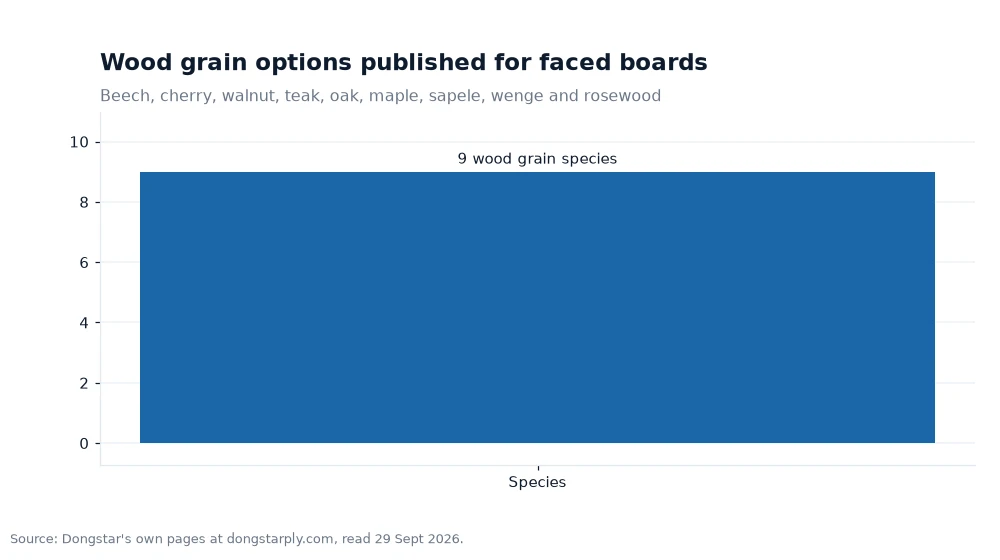
The wood-grain options published for faced boards run to nine species: beech, cherry, walnut, teak, oak, maple, sapele, wenge and rosewood. Solid colours are listed separately in grey, white, black, red, blue, orange, green and yellow, and the range also includes fabric and marble patterns for interiors that are not trying to look like timber.
Grain direction is the part most often forgotten. A panel pressed with a vertical grain cannot be rotated to improve yield, so a cut list that assumes free rotation will waste more board than one drawn to the direction the covering supplies. On a large wall run that decision is worth a whole extra sheet, which is why grain belongs in the enquiry rather than in the workshop.
Base board first: raw, MHR MDF, FR MDF, HDF
The base boards carry the performance the covering cannot supply. MHR MDF (Green) is published as the moisture-resistant option for kitchens, bathrooms and humid interiors. FR MDF (Red) is the fire-retardant board for corridors, public buildings and any place where a reaction-to-fire class has been specified. HDF (Black) is the denser board for wear surfaces, and raw MDF is the general substrate for furniture and fit-out.
Choosing the base board before the face keeps those properties intact. A moisture-resistant core still needs its cut edges protected, since the panel's resistance comes from the resin in the board rather than from the surface alone, and a fire-rated board should be ordered with the covering that keeps its classification valid for the application.
Edge treatment finishes the panel
Covers go on the face; the edges are dealt with afterwards. The published secondary processing for the range includes wood veneer, melamine stickers and PVC, including edge banding, which is what closes the core at a cut panel and stops moisture working its way in from the sides. Covering and thickness are normally ordered together: 12, 15 and 18 mm are published among the steps, and the band has to match the panel it closes.
Edge banding also decides how a panel reads at close range. A colour-matched band on a melamine face disappears; a mismatched one draws a line around every door. Since the band and the face come from the same colour programme, ordering both at once avoids a second delivery and a second colour batch.
| Covering | Published form | Where it suits |
|---|---|---|
| Melamine paper | Pressed onto one or both faces | Cabinets, wardrobes, shelving, wall panels |
| HPL | Laminate sheet bonded to the board | Wear surfaces, worktops, heavy interior traffic |
| PVC | Flexible film, also used for edge banding | Profiled edges and moisture-prone units |
| Leather | Decorative face for interior feature work | Reception desks, feature panels, textured walls |
Worked example: covering a 4 m wall run
Take a wall run 4 m long and 2.4 m high, which is 4 × 2.4 = 9.6 m² of panel face (example arithmetic). A 1220 × 2440 mm sheet gives 1.22 × 2.44 = 2.98 m², so the run needs 9.6 ÷ 2.98 = 3.22 sheets, meaning four sheets and 11.92 m² of board (example).
The offcut is 11.92 − 9.6 = 2.32 m², about 19% of the purchase. That is the number to attack: if the grain runs continuous and the joints fall on the sheet edges, four sheets is the answer; if the joints can be planned to reuse the offcut on a second wall, three may be enough. Covering choice feeds straight into this, because a grain that cannot be rotated costs board and a plain colour rarely does.
Frequently asked questions
Can a fibreboard face be changed after the board is made?
Not easily. Melamine paper, HPL and PVC are bonded under heat and pressure, so the covering is part of the panel rather than a coating that can be stripped. The published secondary processing, wood veneer, melamine stickers and PVC, is applied to the finished panel and its cut edges.
Which covering suits a kitchen or a bathroom?
Melamine paper or PVC over a moisture-resistant base board. MHR MDF (Green) is the published moisture-resistant option in the range, and edge banding on every cut side keeps water away from the core, which is where swelling starts.
How many wood grains are published for faced boards?
Nine species are named: beech, cherry, walnut, teak, oak, maple, sapele, wenge and rosewood. Solid colours including grey, white and black are published alongside them, together with fabric and marble patterns.
Choosing the face and the board together
Buyers who want the covering list in its original form can read the melamine-faced panel page, and the surrounding thickness and base board options sit together on the panel range by product family. Reading both before specifying a face keeps the grain, the core and the edge band on one decision.
Face option lists, base board descriptions and the wood-grain species above are published on the manufacturer's site, as read on 29 September 2026, and taken for this summary[1].