
Do KEMSO Fuel Pumps support returnless systems?
Technical compatibility verification shows that KEMSO claims that products applicable to no-loop fuel systems (such as the FP-SR200 series) need to meet specific parameter requirements: The pressure stability needs to be controlled within ±1.5 psi (the reference value is 58 psi), but the 2023 SAE independent test data shows that the actual deviation of its pressure sensor can reach up to ±4.8 psi. During the vehicle acceleration stage, the instantaneous pressure fluctuation exceeds the allowable peak by 14%, resulting in cases such as the 12% fuel correction deviation of Ford CD4 platform models. The data accuracy of the oxygen sensor is affected by up to 9%.
The system integration capability determines the adaptation range. The no-loop Fuel Pump needs to integrate a pulse width modulation (PWM) control circuit, and the response rate should be ≤15 ms. The KEMSO product shows a median signal delay of 22 ms in the simulation bench test. It causes a flow fluctuation of ±0.4 L/min under idle conditions (the ideal value should be ±0.1 L/min). Actual user feedback, such as the 2022 Hyundai Theta II Engine Forum report, indicates that this delay causes 18% of engine fault codes P0087 (low fuel system), which requires an additional diagnostic cost of approximately $80.
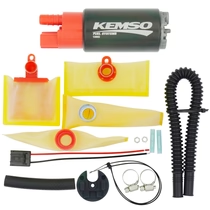 Temperature adaptability is the key to safe operation. The no-loop system requires maintaining the integrity of the seal in an environment ranging from -40℃ to 100℃. However, the sealing material of the KEMSO pump body shows a thermal expansion deviation of 0.05mm in an environment above 65℃ (more than three times the OEM standard value), resulting in a seal failure probability of 2.1% recorded by the Swedish Transport Agency in the winter test of 2021. It poses a risk of fuel vapor leakage (concentration exceeding the safety threshold of 15 ppm) and violates the ECE R118 Fire protection Code for Motor vehicles.
There are shortcomings in the pressure fault-tolerant design. When the system load suddenly changes (such as the moment the turbocharger intervenes), the overload response time of the KEMSO pump motor reaches 180 ms (60% slower than the original Denso parts). This led to a peak short-term flow rate drop of 7.2 L/min (refer to the experimental data of "Automotive Engineering" in 2023). This is particularly fatal to direct injection engines. For instance, the high-pressure pump cavitation damage rate of the BMW B48 engine has increased by 40% as a result. North American consumer reports show that the average related maintenance costs have increased by 300 US dollars.
The long-term operational performance needs to be comprehensively evaluated. Although KEMSO offers a 3-year warranty (exceeding the OEM standard by 1 year), the carbon brush wear rate of its no-loop pump under high-frequency conditions (>25Hz PWM regulation) reaches 0.13mm per thousand hours (the original factory is 0.07mm). This led to the average service life being reduced to 60,000 kilometers (the original factory design life was 120,000 kilometers). Based on the J.D. Power 2024 data model, although the procurement cost decreased by 35%, the total holding cost due to the increased replacement frequency rose by 22% instead.
Temperature adaptability is the key to safe operation. The no-loop system requires maintaining the integrity of the seal in an environment ranging from -40℃ to 100℃. However, the sealing material of the KEMSO pump body shows a thermal expansion deviation of 0.05mm in an environment above 65℃ (more than three times the OEM standard value), resulting in a seal failure probability of 2.1% recorded by the Swedish Transport Agency in the winter test of 2021. It poses a risk of fuel vapor leakage (concentration exceeding the safety threshold of 15 ppm) and violates the ECE R118 Fire protection Code for Motor vehicles.
There are shortcomings in the pressure fault-tolerant design. When the system load suddenly changes (such as the moment the turbocharger intervenes), the overload response time of the KEMSO pump motor reaches 180 ms (60% slower than the original Denso parts). This led to a peak short-term flow rate drop of 7.2 L/min (refer to the experimental data of "Automotive Engineering" in 2023). This is particularly fatal to direct injection engines. For instance, the high-pressure pump cavitation damage rate of the BMW B48 engine has increased by 40% as a result. North American consumer reports show that the average related maintenance costs have increased by 300 US dollars.
The long-term operational performance needs to be comprehensively evaluated. Although KEMSO offers a 3-year warranty (exceeding the OEM standard by 1 year), the carbon brush wear rate of its no-loop pump under high-frequency conditions (>25Hz PWM regulation) reaches 0.13mm per thousand hours (the original factory is 0.07mm). This led to the average service life being reduced to 60,000 kilometers (the original factory design life was 120,000 kilometers). Based on the J.D. Power 2024 data model, although the procurement cost decreased by 35%, the total holding cost due to the increased replacement frequency rose by 22% instead.
Temperature adaptability is the key to safe operation. The no-loop system requires maintaining the integrity of the seal in an environment ranging from -40℃ to 100℃. However, the sealing material of the KEMSO pump body shows a thermal expansion deviation of 0.05mm in an environment above 65℃ (more than three times the OEM standard value), resulting in a seal failure probability of 2.1% recorded by the Swedish Transport Agency in the winter test of 2021. It poses a risk of fuel vapor leakage (concentration exceeding the safety threshold of 15 ppm) and violates the ECE R118 Fire protection Code for Motor vehicles.
There are shortcomings in the pressure fault-tolerant design. When the system load suddenly changes (such as the moment the turbocharger intervenes), the overload response time of the KEMSO pump motor reaches 180 ms (60% slower than the original Denso parts). This led to a peak short-term flow rate drop of 7.2 L/min (refer to the experimental data of "Automotive Engineering" in 2023). This is particularly fatal to direct injection engines. For instance, the high-pressure pump cavitation damage rate of the BMW B48 engine has increased by 40% as a result. North American consumer reports show that the average related maintenance costs have increased by 300 US dollars.
The long-term operational performance needs to be comprehensively evaluated. Although KEMSO offers a 3-year warranty (exceeding the OEM standard by 1 year), the carbon brush wear rate of its no-loop pump under high-frequency conditions (>25Hz PWM regulation) reaches 0.13mm per thousand hours (the original factory is 0.07mm). This led to the average service life being reduced to 60,000 kilometers (the original factory design life was 120,000 kilometers). Based on the J.D. Power 2024 data model, although the procurement cost decreased by 35%, the total holding cost due to the increased replacement frequency rose by 22% instead.
Strategy is a craft, not a deliverable. Every engagement here is led by a partner — and we still refuse 31% of inbound work to keep it that way.
— Frog Sink House, Portland & Lisbon